
Introduction
The Hatch Baby Sound Machine & Night Light (Wi‑Fi, Putty) is a multifunctional bedside device aimed at babies, toddlers, and young kids. It combines white noise, a gentle night light, and a time‑to‑rise alarm into one app‑controlled unit. Parents use it as a nursery sound machine for infants and later as a color‑coded “okay to wake” clock for toddlers who are learning when it’s time to get out of bed.
For shoppers comparing kids’ sleep aids and toddler alarm clocks, this model sits at the higher end of the category, with a typical online price around $79.99 depending on promotions and availability. Instead of just looping a single noise or static light, it focuses on flexible routines and remote control.
Product overview and key features
Design and build
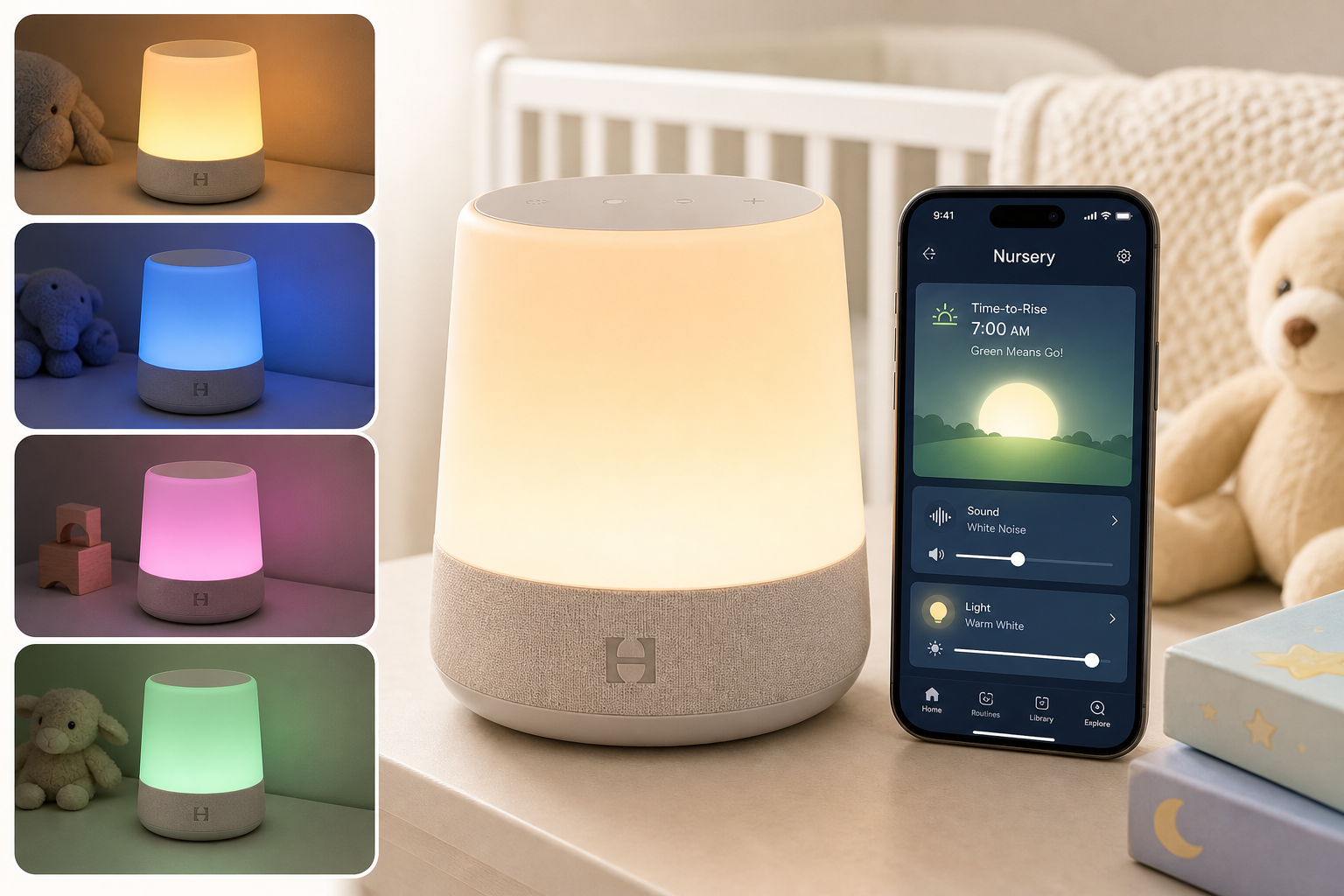
The Hatch Baby Sound Machine & Night Light has a compact, cylindrical design with a soft fabric base and a diffused light dome. The Putty colorway is neutral, intended to blend with modern nursery decor rather than stand out as a toy. The device is small enough to fit on a nightstand or dresser without taking much space.
Key physical elements typically include:
- Diffused LED light around the upper body for soft illumination
- Speaker integrated into the base for white noise and other sounds
- Touch controls on the unit for basic adjustments
- Power adapter for always‑on operation (this is not a battery‑only travel unit)
Overall, the build targets everyday nursery use rather than portability.
Core functions
The device is positioned as a 4‑in‑1 sleep tool:
-
Sound machine
- Plays a selection of white noise and other sleep‑oriented sounds.
- Volume can be finely adjusted, giving parents control over how subtle or strong the sound is.
-
Night light
- Provides adjustable brightness with a range of soft colors.
- Parents can set a dim warm tone for late‑night feeds or diaper changes, or use brighter colors as a visual cue for kids.
-
Time‑to‑rise toddler clock
- Uses colored light (and optionally sound) as a signal to toddlers about when it’s okay to get out of bed.
- For example, the light can stay one color at night and switch to another color at a set wake‑up time.
-
Routine builder
- Through the companion app, parents can set up evening, nap, and morning routines with different combinations of sound, light color, and brightness on a schedule.
App connectivity and controls
A major differentiator is Wi‑Fi connectivity and app control:
- Hatch Sleep app control (iOS/Android):
- Turn the device on/off remotely.
- Change volume, sounds, colors, and brightness.
- Create and manage multiple routines (bedtime, nap, quiet time, time‑to‑rise, etc.).
- On‑device controls:
- Basic touch controls let you operate the unit even if your phone is not nearby or the app connection is interrupted.
- This is useful for babysitters or grandparents who don’t have the app.
The app‑centric design is a core strength for users who like fine‑tuned control, but it does introduce some dependency on Wi‑Fi and smartphones.
Content and sounds
Out of the box, the device provides a selection of built‑in sounds, such as:
- Classic white noise
- Other steady noise variants (e.g., fan‑like sounds)
- Gentle nature or ambient options
Hatch also promotes optional premium content and additional features that may require a subscription. The exact catalog and terms can change over time, so it is best checked directly on the product page before purchase. The important point for most families is that the core white noise and basic features work without mandatory recurring fees.
Performance and user experience
Setup and configuration
Initial setup is designed to be straightforward:
- Plug in the unit near your child’s bed or crib.
- Download the Hatch Sleep app and create or sign in to an account.
- Connect the device to your home Wi‑Fi network following in‑app prompts.
- Name the device (e.g., “Nursery” or your child’s name) and begin configuring routines.
Most households complete setup in a few minutes, although homes with patchy Wi‑Fi or restrictive routers may need an extra attempt to connect. Once online, routine creation is largely menu‑driven and does not require technical expertise.
Everyday use in the nursery
In daily use, the Hatch Baby Sound Machine & Night Light typically becomes a background fixture in the room:
-
For infants:
- Parents tend to rely on white noise plus a very dim warm light for overnight use.
- The ability to tweak brightness and volume from bed using the app is convenient, especially during nighttime feeds.
-
For toddlers and preschoolers:
- The time‑to‑rise feature becomes more important, with parents designing a simple rule such as “Stay in bed while the light is blue; when it turns yellow/green, it’s okay to get up.”
- Some families also use different colors for nap time, quiet time, or reading time.
Brightness control on the night light is fine‑grained enough that most users can find a comfortable level that does not feel harsh in a dark room. The sound from the speaker is typically adequate for small to medium rooms and is tuned more toward steady sleep noise rather than rich music playback.
App experience and reliability
The app experience is central to how this device performs:
- Interface: The layout usually emphasizes quick access to presets and routines, so you can start a bedtime program with a single tap rather than adjusting multiple sliders each night.
- Scheduling: Routines can be scheduled for specific days and times, making weekdays and weekends easier to manage with consistent wake times.
- Remote changes: If a caregiver starts nap time earlier or later than usual, routines can be adjusted on the fly from another room.
As with any connected device, reliability depends partly on home network quality. When Wi‑Fi is stable, control feels responsive. If the network drops, the device will continue running its last program, and on‑device controls remain available, but app adjustments may be delayed until connectivity returns.
Noise quality and light output
For many parents, the value of a sound machine comes down to how it sounds and how the light feels in a dark room:
-
Noise quality:
- The white noise is generally consistent and free from obvious clicks or gaps that might wake a light sleeper.
- There is enough volume headroom to mask typical household sounds in nearby rooms without needing to max out the speaker.
-
Light output:
- The LED ring distributes light evenly, avoiding sharp hotspots that could be distracting.
- At low brightness, it works as a subtle night light; at higher levels, it can serve as a visual wake signal or a soft reading light depending on the room.
Overall, noise and light performance are well matched to bedroom use rather than general room lighting or entertainment.
Pros and cons
Pros
- All‑in‑one design combining sound machine, night light, and time‑to‑rise toddler clock in a single device.
- Strong app integration, allowing remote control and detailed routine scheduling, including separate settings for bedtime, nap time, and morning wake‑ups.
- Fine‑grained control over volume, light brightness, and color, making it easier to tailor the environment to different ages and sensitivities.
- Grows with the child, transitioning from baby white noise and night feeds to toddler sleep training and okay‑to‑wake cues.
- On‑device controls provide basic functionality even without a phone or when guests and babysitters are involved.
- Neutral, modern design in the Putty color that fits into most nursery and kids’ room aesthetics.
Cons
- Higher upfront cost compared to simple plug‑in night lights or basic white noise machines, even when purchased around $79.99.
- Dependence on Wi‑Fi and a smartphone app for full functionality, which may not suit households that prefer fully offline devices.
- Optional subscription ecosystem for certain content and features, which some buyers may perceive as added complexity beyond the initial purchase.
- Not intended as a portable, battery‑powered solution, so it is less convenient for travel or use away from an outlet.
Conclusion and recommendation
The Hatch Baby Sound Machine & Night Light (Wi‑Fi, Putty) is best suited for parents who want more than a basic white noise box. Its strength lies in combining multiple child‑sleep functions—sound machine, night light, and time‑to‑rise training—under one cohesive system with app‑driven routines.
Families who value simple, offline devices may find it more complex than necessary, and the premium pricing tier around $79.99 means it is an investment rather than an impulse buy. However, for households that already use smart devices and appreciate the ability to fine‑tune schedules from their phones, it can effectively replace several separate products.
If you are building a nursery or upgrading from a simple sound machine and want a product that can support both baby sleep and toddler habit‑building over several years, the Hatch Baby Sound Machine & Night Light is a strong, feature‑rich option to consider at its current price point on Amazon: https://www.amazon.com/dp/B0F7C6XJ3P.