
Product Context
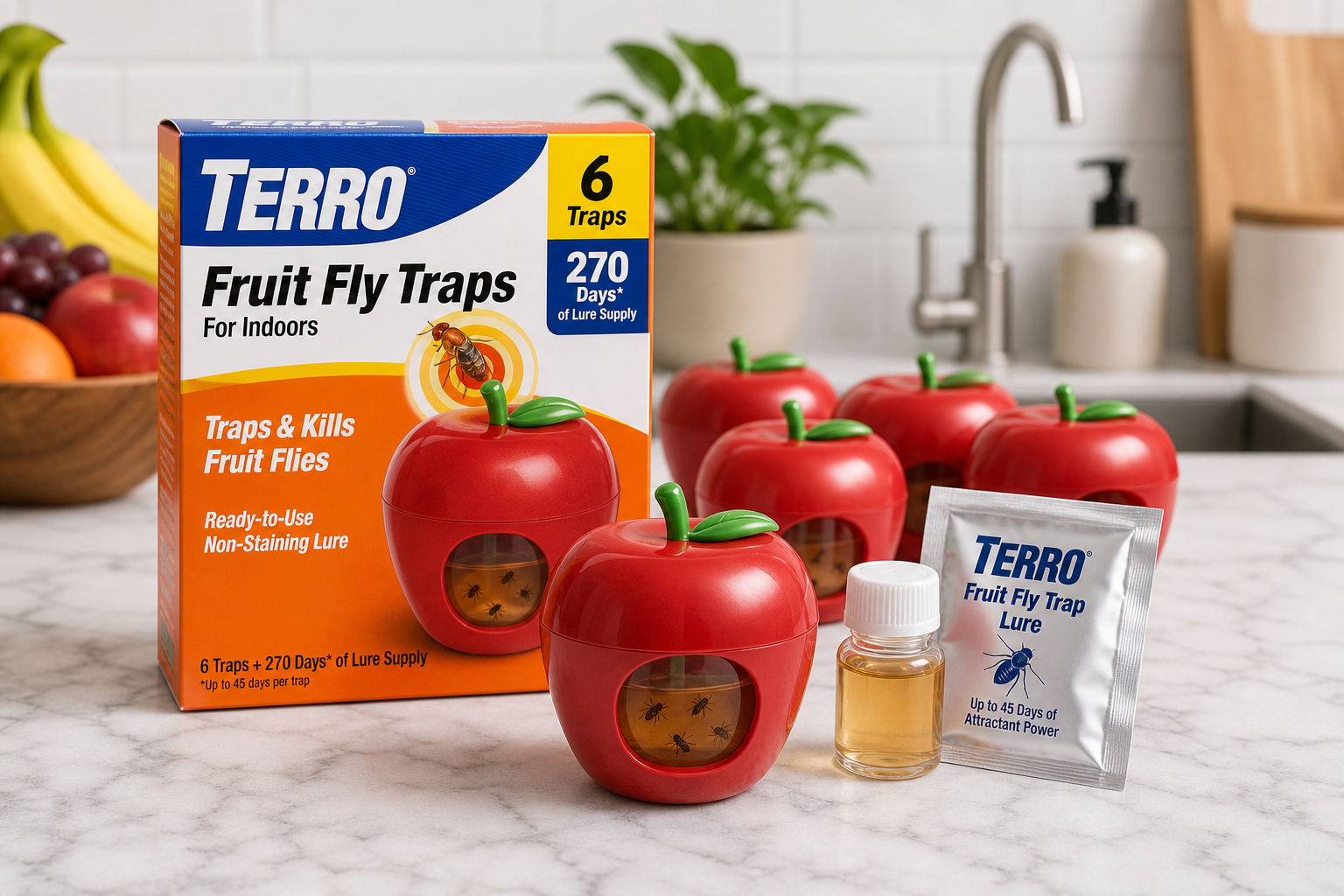
The Terro Fruit Fly Traps for Indoors (6 Pack) + 270 Days of Lure Supply are designed for homeowners dealing with recurring fruit fly problems around kitchen counters, compost pails, trash cans, and other food-preparation areas.
Instead of relying on homemade vinegar-and-soap bowls or broad-spectrum insect sprays, this product uses a pre-formulated, food-based liquid lure and a compact plastic trap shaped like an apple. Each package includes:
- 6 reusable apple-shaped traps
- Enough liquid lure for up to 270 days of coverage (with each lure refill intended to last up to about 45 days per trap, depending on conditions)
The value proposition is straightforward: you set the traps near known breeding or feeding hotspots and let the lure attract and contain adult fruit flies over an extended period. While pricing can fluctuate, this kit is generally positioned as an affordable, multi-month solution for typical home kitchens at around $21.42.
Feature Breakdown
1. Apple-Shaped Trap Design
- Discreet appearance – The traps are molded to look like small apples, which helps them blend into countertop fruit bowls or kitchen decor rather than advertising the presence of pests.
- Low footprint – Their compact size makes them easy to tuck near sinks, compost caddies, or recycling areas without taking up much space.
- Built-in viewing window – A small transparent window in the housing allows you to see both the lure level and the number of trapped flies so you know when to refresh or discard a trap.
2. Food-Based Liquid Lure
- Non-staining formula – The lure is designed to be non-staining when used as directed, reducing the risk of damage if there’s a small spill during setup.
- Targeted to fruit flies – It’s formulated to attract adult fruit flies specifically, mimicking the fermenting fruit and organic residues they prefer.
- Long-lasting action – Each refill is marketed to remain effective for several weeks at a time, contributing to the advertised total of 270 days of lure supply when used as directed.
3. Ready-to-Use Workflow
- Simple assembly – In typical use, you fill the trap with the provided lure, close it, and place it where flies are active—no mixing, heating, or measuring required.
- Passive operation – Once set up, the trapping process is fully passive: flies are drawn in through the entry ports and cannot easily escape.
4. Indoor-Focused Use
- Best suited for kitchens and food areas – The lure is optimized for fruit-fly pressure in indoor environments where decaying fruit, food residue, or moist organic matter is present.
- Not a general fly killer – It is not designed for houseflies, fungus gnats, or outdoor use in high-wind or rain-exposed areas.
Performance Insights
Effectiveness Against Fruit Flies
In typical kitchen scenarios—overripe fruit on the counter, a compost pail that’s not emptied frequently, or a recycling bin with sticky beverage residue—the Terro traps can noticeably reduce adult fruit fly populations within a few days once placed near the source.
Key performance characteristics:
- Speed of results – Many users report seeing flies inside the traps within the first 24–72 hours, with a visible reduction in swarming around fruit bowls and sinks over that timeframe.
- Sustained control – Because each lure dose is meant to last for several weeks, the traps can provide ongoing suppression through a full fruit fly season, rather than acting as a one-time knockdown.
- Dependence on placement – Performance is strongly influenced by how close the traps are to the actual breeding site. Placing them directly next to fruit bowls, trash cans, compost containers, or dirty drains tends to yield better catch rates.
When Performance May Be Limited
There are a few recurring patterns seen when traps underperform:
- Competing food sources – If overripe fruit, uncovered trash, or unclean drains are left unaddressed, flies may continue to prefer those sources over the trap.
- Misidentified pests – Fungus gnats, drain flies, or other tiny flying insects are sometimes mistaken for fruit flies. These species may not respond as well to a fruit-fly-specific lure.
- Heavily infested environments – In extreme infestations (for example, in commercial-style kitchens or neglected spaces), traps alone may not be sufficient without a deeper sanitation effort.
Comparison with DIY Traps
Compared with homemade vinegar or wine traps in open cups, the Terro system offers:
- Cleaner containment – Flies are hidden inside the opaque, apple-shaped body rather than floating in a visible bowl of liquid.
- More controlled lure formulation – The lure’s consistency and potency are standardized, reducing guesswork about whether your mixture is attractive enough.
- Longer service intervals – The lure is designed to last longer than many DIY mixes, which can evaporate or lose their scent quickly.
On the other hand, DIY traps still appeal if:
- You want a no-purchase solution using products already in your pantry.
- You prefer to fine-tune lure recipes (for example, experimenting with different vinegars or adding dish soap) and are comfortable refreshing them frequently.
Usability
Setup and Maintenance
- Initial setup – Opening the trap, adding the liquid lure, and closing it securely is straightforward. Instructions are typically illustrated and require no tools.
- Placement – Best practice is to position the traps as close as possible to where you actually see the flies—fruit bowls, compost or food-scrap caddies, trash cans, or sticky recycling bins.
- Monitoring – The built-in window makes it easy to:
- Check whether flies are being caught.
- See when the lure has evaporated or become saturated with debris.
- Replacement – Once a trap has been in service for its recommended duration or is visibly full, you can dispose of the contents (or the entire unit, depending on your preference and local recycling rules) and set up a new trap with fresh lure.
Safety and Indoor Friendliness
- Non-spray approach – Since this is a passive bait trap, it avoids the aerosolized chemicals and overspray associated with many insecticides.
- Non-staining lure – When handled carefully, the lure is less likely to leave permanent marks on counters or shelves.
- Odor profile – The lure has a noticeable but localized scent designed to be attractive primarily to flies. In a typical kitchen, most users consider it tolerable, though those with heightened sensitivity to smells may prefer to keep traps slightly away from seating areas.
Suitability for Different Households
- Small apartments and condos – The compact traps are a good match for limited counter space and can be moved easily as needed.
- Family homes – For households with busy kitchens, the long lure duration and six-trap kit support coverage in multiple zones at once (kitchen, pantry, near indoor trash, etc.). As with any pest-control device, traps should be positioned out of reach of very young children.
- Pet owners – The enclosed design makes the lure less accessible to curious pets compared with open bowls of vinegar, though keeping traps out of direct reach is still wise.
Trade-offs
Advantages
- Long service life – The included lure supply is intended to cover many months of use, reducing the need for frequent repurchases.
- Discreet, decor-friendly look – The apple shape blends in better than utilitarian plastic stations or open DIY containers.
- Easy visual monitoring – You can quickly confirm whether the trap is working without opening it.
- Low-effort maintenance – Once placed, each trap can be left in position for its full lure life with only occasional checks.
Limitations
- Not a standalone solution in severe infestations – Without addressing the underlying breeding sites (dirty drains, spoiled produce, unsealed compost), even effective traps may only make a partial dent in a large population.
- Fruit-fly specific – If your primary issue is fungus gnats from houseplants, drain flies, or regular houseflies, you may need species-specific alternatives.
- Single-use plastic concerns – While compact, the traps still add plastic waste over time if discarded after each cycle.
- Variable individual results – Because success depends heavily on kitchen hygiene, pest identification, and placement, some households may see less dramatic improvements than others.
Value Considerations
With six traps and a multi-month supply of lure in a single box, the per-trap, per-day cost is designed to be modest, especially when purchased at a typical price point near $21.42. Households facing recurring seasonal fruit fly waves may find that the extended coverage offsets the cost compared with repeatedly improvising short-lived DIY setups.
Conclusion
The Terro Fruit Fly Traps for Indoors (6 Pack) + 270 Days of Lure Supply offer a thoughtfully packaged, low-effort way to control fruit flies in kitchens and other indoor food areas over an extended period. Their strengths lie in the long-lasting, food-based lure, the discreet apple-shaped housing with a monitoring window, and the ability to deploy multiple traps around common breeding sites simultaneously.
They are best suited for:
- Households that experience recurring seasonal fruit fly problems and want a cleaner, more discreet alternative to open DIY bowls.
- Users who prioritize ease of use and long service intervals over constant tinkering with homemade lures.
They are less ideal if you are:
- Dealing primarily with non–fruit fly pests like fungus gnats or drain flies.
- Looking for a single, one-time fix without also improving sanitation and eliminating breeding sources.
Used as part of a broader strategy that includes disposing of overripe fruit promptly, cleaning drains, and managing compost or food waste, these Terro traps can be an effective, set-and-forget component of indoor fruit fly control that aligns convenience with long-term coverage.