
Introduction
Apple’s HomePod mini has become the default smart speaker for many Apple‑centric homes, and the Apple HomePod mini – Yellow adds a bright, expressive finish to the lineup. Designed to be a compact smart speaker and HomeKit hub, it targets users who want hands‑free control of music, smart home devices, and Siri, without giving up much desk or counter space.
On Amazon, the yellow HomePod mini typically sits around $149.00, which places it squarely in the mid‑range smart speaker category. This review focuses on how the yellow version looks, sounds, and performs in everyday use, and whether it’s still a good buy today.
Product overview and key features
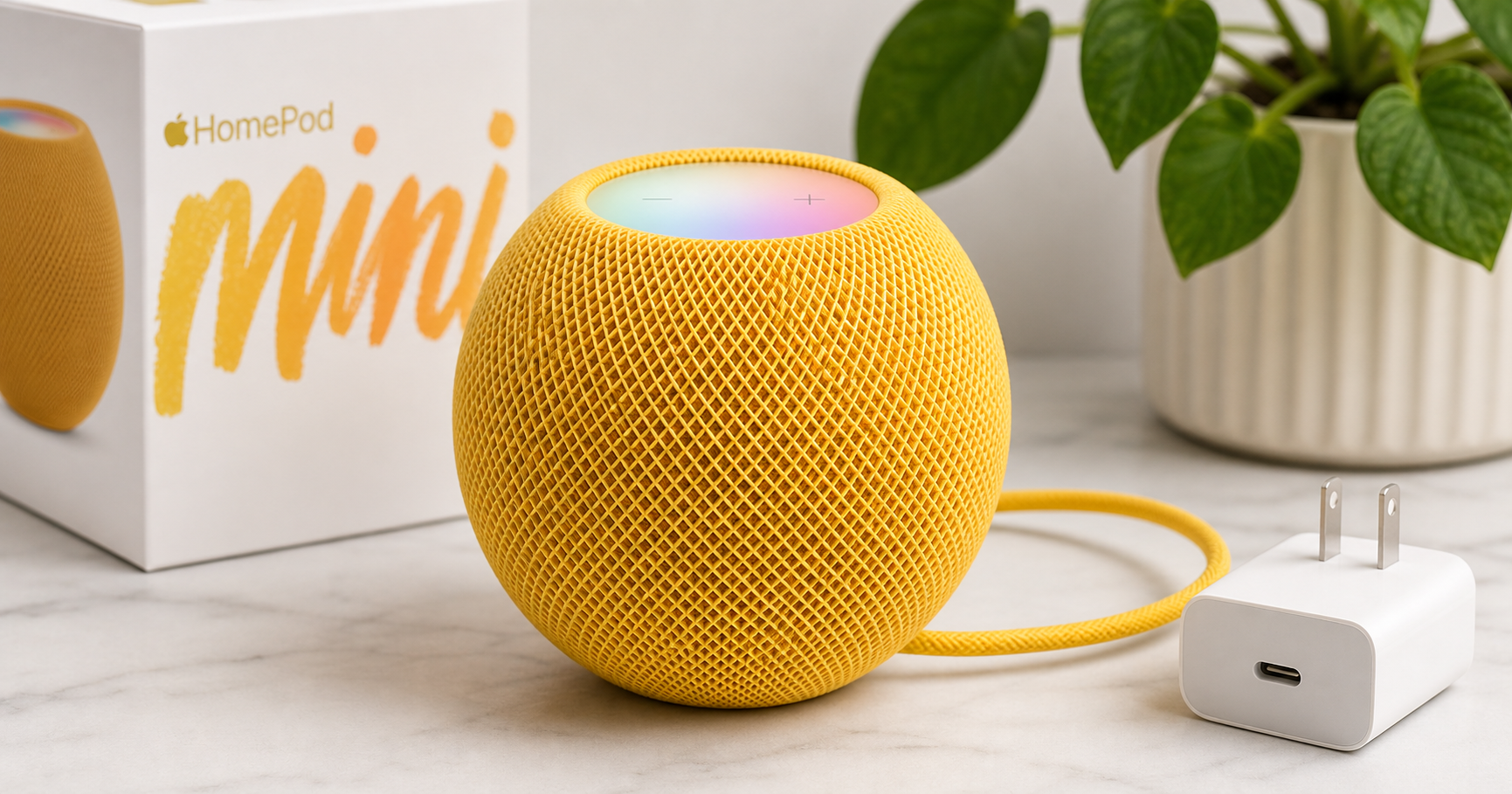
At its core, the yellow HomePod mini is functionally identical to other color variants; the difference is cosmetic. It retains the same spherical design with a flat top, wrapped in acoustically transparent mesh fabric. The yellow model extends the color through the mesh, the power cable, and the tinted touch surface, giving it a cohesive, playful look that works well in kitchens, bedrooms, or creative workspaces.
Design and build
- Form factor: About 3.3 inches (84.3 mm) tall and 3.9 inches (97.9 mm) wide, weighing roughly 0.76 lb (345 g). It’s genuinely compact, similar to other palm‑sized smart speakers.
- Finish: Bright yellow mesh fabric with matching cable and subtle yellow tint on the top surface.
- Controls: A backlit touch surface on top handles play/pause, volume up/down, track skipping (double/triple tap), and touch‑and‑hold for Siri.
The build quality is solid, with the typical tight tolerances and clean seams expected from Apple. The woven power cable is permanently attached and leads to an included 20 W USB‑C power adapter.
Core features
Key capabilities include:
- 360° audio: A full‑range driver with dual passive radiators, coupled with a custom acoustic waveguide, disperses sound evenly in all directions.
- Computational audio: On‑board processing optimizes loudness and tonal balance in real time, adjusting for volume level and content.
- Far‑field microphones: Four microphones listen for “Hey Siri,” even while music is playing, with decent noise rejection.
- Smart home hub: Acts as a Home hub for Apple Home (HomeKit), enabling remote access, automation, and Thread support for compatible accessories.
- Temperature and humidity sensors: Built‑in sensors can feed data into the Apple Home app, enabling environment‑based automations (like turning on a fan when a room gets too warm).
- Multiroom and stereo pairing: Supports AirPlay 2 for multiroom playback and stereo pairing with another HomePod mini of the same generation.
- Connectivity: 802.11n Wi‑Fi, Bluetooth 5.0, Ultra Wideband for proximity‑based handoff with supported iPhones, and Thread networking for low‑power smart home devices.
Ecosystem integration
The HomePod mini is tightly integrated with Apple services and devices:
- Audio sources: Apple Music, iTunes purchases, iCloud Music Library (with Apple Music or iTunes Match), popular radio services, Apple Podcasts, and AirPlay from any Apple device.
- Siri: Handles music playback, smart home control, reminders, calendar queries, messaging and calling (via your iPhone), and basic information requests.
- Intercom: Lets you send voice messages between HomePods and to Apple devices in your home, helpful in multi‑room households.
Because of this tight integration, the HomePod mini makes the most sense if you already use iPhone, iPad, or Mac and are at least moderately invested in Apple services.
Performance and user experience
Audio quality
For its size, the HomePod mini produces a surprisingly full and coherent sound:
- Tonal balance: Slightly warm, with emphasis on mids and upper‑bass. Vocals and spoken word content (podcasts, audiobooks) come through clearly.
- Bass: More presence than you’d expect from a speaker this small, thanks to the dual passive radiators and computational audio, but it won’t replace a dedicated bookshelf system or subwoofer. In louder, larger rooms, bass impact falls off.
- Highs: Clean and reasonably detailed at moderate volumes. At the upper end of the volume range, brightness can increase, but not to a harsh level for most listeners.
- Soundstage: The 360° dispersion works well in open spaces or when the speaker is placed centrally. For background listening, it fills small and medium rooms effectively.
The yellow finish does not alter the acoustic design, so sound quality is in line with other HomePod mini variants.
Voice recognition and Siri
The far‑field microphone array listens reliably for the wake phrase, even with music playing at moderate levels. In typical household conditions:
- Siri generally recognizes commands at a conversational volume from several meters away.
- Noise (like running water or exhaust fans) can necessitate raising your voice slightly but rarely requires shouting.
Siri’s capabilities are strongest in Apple’s own ecosystem: controlling HomeKit devices, playing Apple Music content, sending messages via iPhone, setting reminders, timers, and calendar events. Third‑party music services support varies by region and may require relying on AirPlay from your phone.
Smart home and sensors
As a Home hub, the HomePod mini enables:
- Remote control: Operate Home‑compatible devices when you’re away from home.
- Automations: Time‑based or condition‑based flows (for example, turning lights on at sunset or starting an air purifier when you arrive home).
- Thread support: For compatible accessories, Thread offers low‑power, mesh‑style connectivity that can boost reliability compared to Wi‑Fi or Bluetooth alone.
The temperature and humidity sensors unlock additional automation possibilities, such as:
- Turning on a smart plug connected to a fan if a room exceeds a set temperature.
- Adjusting smart blinds or thermostats based on humidity or warmth.
These features make the HomePod mini particularly valuable as an inexpensive smart home backbone when paired with compatible devices.
Daily usability
In everyday use, the HomePod mini feels consistent and low‑maintenance:
- Setup: Quick and straightforward with an iPhone or iPad—just bring your device close, follow the on‑screen wizard, and assign the HomePod mini to a room.
- Handoff: With a supported iPhone, you can bring your phone near the HomePod mini to transfer audio playback to the speaker.
- Multiroom audio: Adding several HomePod minis around the home enables synchronized playback, which works well for whole‑home music.
The permanent cable and external 20 W adapter keep the footprint small but limit some placement options compared with fully detachable power solutions. Still, for most desks, countertops, and shelves, the cable length is adequate.
Pros and cons
Pros
- Compact, unobtrusive size that fits easily on desks, nightstands, and countertops.
- Bright yellow finish adds personality and blends well into colorful or modern interiors.
- Solid, room‑filling 360° sound for its size, especially at moderate listening levels.
- Deep integration with Apple devices, services, and the Apple Home ecosystem.
- Built‑in temperature and humidity sensors support environment‑aware automations.
- Functions as a Home hub with Thread support for compatible smart home accessories.
- Reliable far‑field voice pickup for Siri, even with background music.
- Simple setup and intuitive touch controls.
Cons
- Best suited for Apple users; Android and cross‑platform households get a more limited experience.
- Bass extension and maximum volume can’t compete with larger speakers or dedicated audio systems.
- No aux input or Bluetooth audio input mode; relies on Wi‑Fi and AirPlay.
- Permanently attached power cable slightly reduces flexibility for cable replacement.
- Siri can feel more limited than some competing voice assistants when it comes to third‑party services and open‑ended queries.
Conclusion and recommendation
The Apple HomePod mini – Yellow is a well‑rounded compact smart speaker that leans heavily into Apple’s ecosystem strengths. It offers respectable 360° audio, a bright and distinctive design, and meaningful smart home features—including sensors and Thread support—in a very small footprint.
If you primarily use Apple devices, rely on Apple Music or are comfortable using AirPlay, and want a smart speaker that doubles as a capable Home hub, the yellow HomePod mini is easy to recommend at around $149.00. It’s particularly compelling for:
- Adding voice control and automation to specific rooms (kitchens, bedrooms, offices).
- Building a multiroom audio setup using several HomePod minis.
- Users who appreciate a playful color option that stands out from standard white or black speakers.
Users who prioritize maximum audio output, broad cross‑platform support, or deep integration with non‑Apple services may want to consider larger or more open ecosystem speakers. But for Apple‑centric households seeking a colorful, compact smart speaker, the yellow HomePod mini remains a strong and balanced choice.